Introduction
The Nara period (710-794) represents the first sustained attempt by the Japanese court to construct a centralized imperial state grounded in codified law, bureaucratic administration, and cosmological legitimacy. Anchored in the establishment of a permanent capital at Heijo Kyo, the period is often associated with the maturation of the ritsuryo system, a legal-administrative order derived from Tang China. Yet modern scholarship has increasingly emphasized that this system was never fully realized in practice. Rather than a stable apex of early state formation, the Nara period should be understood as a dynamic and tension-filled experiment, in which institutional ambition was constrained by material, social, and political limitations.¹
The Ritsuryo State: Ideology and Institutional Design
The foundations of the Nara state lay in earlier reform efforts, particularly the Taiho Code, and subsequent Yoro Code, which articulated a comprehensive vision of governance modeled on Chinese precedents. These codes established a centralized bureaucracy organized into ministries, a hierarchical ranking system for officials, and a provincial administrative structure under gubernatorial oversight.²
At the ideological level, the ritsuryo system positioned the emperor as the apex of both political and cosmological order. Drawing upon Confucian notions of hierarchy and Legalist administrative principles, the state sought to regulate society through codified law and ritualized authority.³ However, as Joan R. Piggott has argued, this framework was less a reflection of existing realities than a normative blueprint, projecting an idealized vision of centralized rule that was only partially realized on the ground.⁴
The land allocation system exemplified this gap between theory and practice. In principle, all land belonged to the state and was periodically redistributed to cultivators in exchange for taxation and labor obligations. In practice, administrative limitations, population pressures, and local resistance undermined the system’s sustainability.⁵
Heijo Kyo and the Spatialization of Imperial Authority
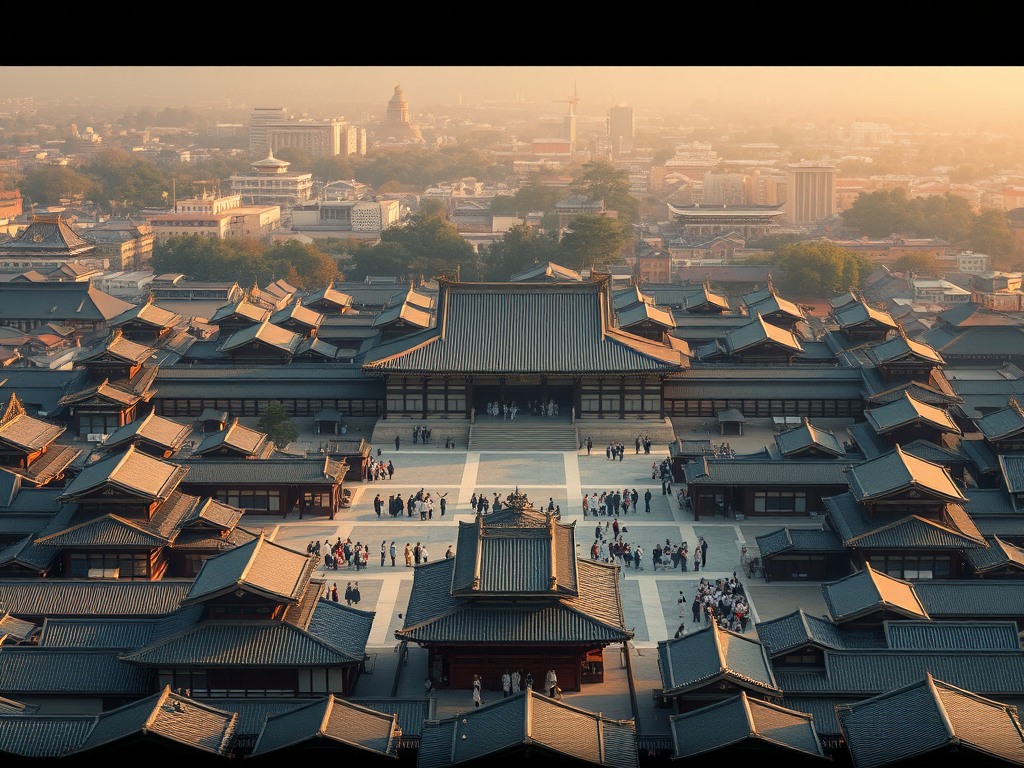
The establishment of Heijo Kyo in 710 marked a decisive shift toward a sedentary model of governance. Designed on a grid pattern modeled after Tang capitals, the city embodied the ideological aspirations of the state: order, hierarchy, and centralized control.⁶ The spatial organization of the capital, centered on the imperial palace and surrounded by bureaucratic institutions, functioned as a material expression of political authority. Ritual processions, court ceremonies, and administrative routines reinforced the emperor’s symbolic centrality.⁷
Yet the maintenance of a capital of this caliber imposed substantial economic burdens. As George Sansom notes, the costs of sustaining the court, constructing infrastructure, and supporting a large bureaucratic apparatus strained the agrarian economy upon which the state depended.⁸ These pressures would have lasting consequences for the viability of centralized governance.
Buddhism and the Construction of State Ideology
One of the most distinctive features of the Nara period was the integration of Buddhism into the framework of state authority. Under rulers such as Emperor Shomu, Buddhism was actively promoted as a means of legitimizing and stabilizing the polity.
Shōmu’s policies included the establishment of provincial temple networks and the construction of Todai-ji, whose Great Buddha (Daibutsu) symbolized both spiritual protection and imperial authority.⁹ These initiatives reflect what scholars have termed “state Buddhism”, the deliberate alignment of religious institutions with political objectives.¹⁰
At the same time, this alliance generated new tensions. Buddhist institutions accumulated land, wealth, and influence, often operating with a degree of autonomy that challenged central authority. The prominence of clerical figures at court, most notably the monk Dokyo, illustrates the potential for religious actors to intervene directly in political affairs.¹¹ As William Wayne Farris observes, the very success of state-sponsored Buddhism contributed to the erosion of the state’s autonomy.¹²
Literary Production and the Legitimation of Rule
The Nara period saw the compilation of foundational historical and literary texts, including the Kojiki and Nihon Shoki. These works were not merely chronicles but instruments of political legitimation, constructing a narrative of imperial descent from divine origins and integrating regional traditions into a unified historical framework.¹³
The Man’yoshu, an extensive poetry anthology, offers a broader cultural perspective, encompassing both elite and non-elite voices. As Donald Keene has argued, the anthology reflects a society in which cultural production was not yet fully monopolized by the court, revealing a degree of social diversity often obscured in official histories.¹⁴
Material culture further underscores the cosmopolitan nature of Nara Japan. The Shosoin repository preserves artifacts from across Eurasia, attesting to the continued integration of Japan into transregional exchange networks.¹⁵
Economic Strain and the Emergence of Structural Decentralization
Despite its institutional sophistication, the Nara state faced persistent economic challenges. The taxation system, based on agricultural production and labor, placed significant burdens on the peasantry, leading to evasion, migration, and social instability.¹⁶
In response to these pressures, the state enacted policies permitting the reclamation and private ownership of land, most notably the edict of 743. While intended to stimulate agricultural expansion, these measures facilitated the growth of tax-exempt private estates, also called shoen.¹⁷ As Conrad Totman emphasizes, this process marked the beginning of a long-term transition from public to private landholding, fundamentally altering the structure of Japanese society.¹⁸
Religious Syncretism and Social Integration
The spread of Buddhism did not displace indigenous religious practices but instead contributed to a process of syncretism. Local kami worship was integrated into Buddhist frameworks, producing a layered religious environment that accommodated both traditions.¹⁹
This syncretism facilitated the diffusion of Buddhism beyond the court, embedding it within local communities while preserving regional identities. It also reflects a broader pattern in Japanese history: the selective adaptation of external influences within existing cultural frameworks.
Crisis, Reform, and the Transition to Heian
By the late eighth century, the contradictions of the Nara system had become increasingly apparent. The concentration of power in Buddhist institutions, the erosion of the tax base, and the growing influence of aristocratic factions all contributed to political instability.
The decision by Emperor Kanmu to relocate the capital, first to Nagaoka and then to Heian Kyo in 794, was motivated in part by a desire to reassert imperial control and reduce the influence of entrenched religious interests.²⁰ This transition did not mark the abrupt collapse of the ritsuryo system but rather its gradual transformation. Many of its formal structures persisted, even as their practical significance declined.
Conclusion
The Nara period occupies a pivotal position in Japanese history as the first sustained effort to construct a centralized imperial state grounded in codified law and bureaucratic governance. Yet its significance lies as much in its limitations as in its achievements. The adoption of continental institutions, the integration of Buddhism into state ideology, and the establishment of a permanent capital all reflect an ambitious vision of political order. At the same time, economic strain, religious competition, and local autonomy exposed the fragility of this system.
Rather than a stable culmination of early state formation, the Nara period should be understood as a transitional and generative phase, whose contradictions shaped the evolution of Japanese political and social structures in subsequent centuries.
Footnotes
- George Sansom, A History of Japan to 1334 (Stanford: Stanford University Press, 1958), 71-75.
- Joan R. Piggott, The Emergence of Japanese Kingship (Stanford: Stanford University Press, 1997), 143-150.
- Conrad Totman, Early Modern Japan (Berkeley: University of California Press, 1993), 23-25.
- Piggott, Emergence of Japanese Kingship, 152.
- William Wayne Farris, Heavenly Warriors: The Evolution of Japan’s Military, 500-1300 (Cambridge: Harvard University Asia Center, 1992), 54-58.
- Delmer M. Brown et al., eds., The Cambridge History of Japan, Vol. 1: Ancient Japan (Cambridge: Cambridge University Press, 1993), 255-260.
- ibid., 262-265.
- Sansom, History of Japan, 80-84.
- Brown et al., Cambridge History of Japan, 274-280.
- Kuroda Toshio, “Shinto in the History of Japanese Religion,” Journal of Japanese Studies 7, no. 1 (1981): 6-8.
- Sansom, History of Japan, 95-98.
- Farris, Heavenly Warriors, 61.
- Brown et al., Cambridge History of Japan, 305-310.
- Donald Keene, Seeds in the Heart: Japanese Literature from Earliest Times to the Late Sixteenth Century (New York: Columbia University Press, 1999), 63-70.
- Brown et al., Cambridge History of Japan, 289-292.
- Farris, Heavenly Warriors, 58-60.
- Sansom, History of Japan, 90-92.
- Totman, Early Modern Japan, 28-30.
- Kuroda, “Shinto in the History of Japanese Religion,” 10-12.
- Brown et al., Cambridge History of Japan, 320-325.